
Salad Introduction
Salad (www.salad.or.kr), Korea’s first multicultural theater company, was established in January 2009 to discover the true meaning of cultural diversity through communication that transcends the cultural boundaries of immigration and settlement. Major social services include performance and cultural arts education projects to promote international understanding and cultural diversity, the operation of Korea’s first multicultural theater Salad Boom, immigrant performing arts academy projects, and immigrant artist support projects. In 2014, it was certified as a social enterprise by the Ministry of Labor, and to date, a total of 300 workshops and 250 performances have been held, reaching over 40,000 audiences nationwide.
Salad is establishing itself as the only art organization in which immigrants directly participate in its creation. The main members are immigrants who immigrated to Korea mainly from Asia, such as China, Mongolia, the Philippines, Nepal, and Vietnam. When the theater company was founded in 2009, it started with the motto, “Immigrant Women’s Theater Company.” Over the years, new members from migrant workers, international students, and artists have been added, making the members’ countries of origin and occupations more diverse.
Social Theater ‘A Play Without Actors’
The theater company is a ‘social theater’ and in its early days, it mainly performed ‘human rights plays’ that dealt with multicultural issues in Korean society. Creative performances such as ‘Ran’s Diary’, ‘Yeosu Beginning, Middle and End’, and ‘Future Story’ are such works. ‘Lan’s Diary’ tells the true story of a Vietnamese immigrant woman who died after entering the country through an international marriage. In addition, ‘Yeosu Beginning, Middle and End’ dealt with the Yeosu foreigner shelter fire incident, and ‘Future Story’ dealt with the stories of Koreans living in Japan and refugees. In all three works, migrant women, migrant workers, and refugees appeared on stage as actors. In 2013, this work was performed at the small theater of Arko Arts Theater in Daehakro under the title ‘A play without actors.’ All were performed in Korean, and the target audience was adults.
Multicultural Creative Musical
Since 2011, with the support of Shinhan Bank, we have been producing original musicals that intensively introduce Asian culture. The purpose is to convey the story of cultural diversity to a wide range of audiences, including children, teenagers, and families, through a musical incorporating Asian folk songs and traditional dances.
There is an important reason why we want to introduce Asian culture intensively. Looking at the nationality distribution of immigrants, a high proportion of immigrants come from Asia, including China, Vietnam, the Philippines, Thailand, and Mongolia. In order to live well with immigrants, we need to understand their culture well. In particular, performances that are watched not only by adults but also by children, teenagers, and families are more effective in spreading cultural diversity because they can secure a wider audience.
There are now 2.5 million immigrants living in our society. Therefore, performance content that is easier to understand and more interesting has become more necessary. The Asian cultures introduced in Salad so far are those of eight countries: Nepal, China, the Philippines, Mongolia, Vietnam, Indonesia, India, and Myanmar.
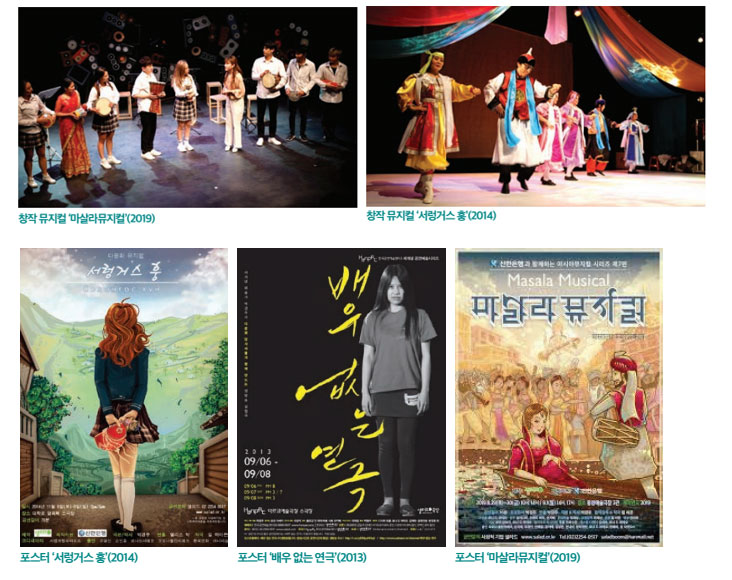
Asia’s intangible cultural heritage that crosses borders
Each work uses a representative folk song as its theme song and essentially introduces a traditional dance to the theme song. The most difficult part of introducing Asian culture over the past eight years is that there are not many Asian cultural materials in Korean. To complement this, Salad researches and organizes cultural materials by involving immigrant artists or experts from that country as coordinators in each creative musical work from the production stage. In cases where it was difficult to obtain local data in Korea, we solved the problem by connecting with local experts through human networks.
In the case of the Nepalese folk song ‘Retsampiriri’, it was chosen as the theme song for the original musical ‘Marina and Bize’ in 2011, but there was no Korean translation, so Korean lyrics were created by referring to Japanese and English translation materials. This song was also sung by people in Nepal in various versions with various lyrics. Actress Vimala Schrester, who was working with Salad Theater Company at the time, majored in traditional dance in Nepal, so she played a big role in organizing these materials and selecting lyrics that suited us. She also made one dance costume herself.
The same goes for the Indonesian folk song ‘Dayung Ssampan’. Because it was known as the theme song for the movie ‘Cheommilmil’ in Korea, it was difficult to search for information on the Internet. At this time, I consulted with local Indonesian expert Melati Shrodamo through my personal network and received advice. When creating Korean lyrics, there was also the difficulty of having to use an English translation and a translator. In the case of folk songs, it was difficult to obtain Western-style sheet music. So, after researching the sound source material, Salad music director and composer Hill Hizon created a new sound source and sheet music to match the Salad performance. The writer in charge of writing and writing the play added the original pronunciation and adapted lyrics. According to the completed song, we researched traditional dance materials, created choreography, and made or purchased costumes locally.
Because the production team was not a traditional arts expert with comprehensive expertise in all Asian cultures, they had to study from scratch every year when introducing a new country’s culture. Going through this process every year to complete a stage was truly hard work.
A better future ‘Salad Bowl’
Children and youth audiences are the most important and grateful audience for Salad creative musical performances. They find folk songs and dances that may seem unfamiliar to them interesting and genuinely enjoy them. Salad has performed many school visits. I am happiest when I see children singing Asian folk songs as they return to class after watching Salad performance. A future image of Korean society where various cultures coexist. When these children grow up, will the society be able to communicate and achieve harmony with other cultures? Salad wants to play a small role in making peace, communication, and coexistence possible in that future.
- writing. Park Kyong Ju. CEO of Social Enterprise Salad –
- Magazine ‘Monthly Cultural Heritage’ December 2019 issue
Original Text Link
 PARK KYONG JU