Agnes Schofield (Curator of the artist residency Schloss Balmoral)
You can lose yourself in sounds, series, literature or even other people and their biographies. This is what happened to artist Park Kyong Ju, who lived at the Artist Residency Schloss Balmoral for eight months and dedicated herself to the fate of the late Tran Thanh Lan.
A ghost house is usually located in a temple or in the house or even in front of the shop of the family of the deceased. According to Confucian tradition, steles inscribed with names – very important in Asian culture – are kept there to commemorate the deceased. No ashes, no relics. Only the writing commemorates the person. GhostHouse (2024) is also a work of art created by Park Kyong Ju. In this shrine, however, there are no names but quotes from the diary of the deceased Tran Than Lan. The Vietnamese woman went to Korea on 11 January 2008. She met her future husband through a marriage broker. A quick wedding took place in Ho Chi Minh City, Vietnam. Less than a month later, on 6 February 2008 at 9 am, she was found dead. The police suspected suicide by jumping from the balcony.
Park Kyong Ju does not believe this version of the story. The artist, as well as the mother of the deceased, see their suspicions confirmed by Tran Thanh Lan’s diary, which the police did not consider in their investigation. Selected phrases and words from this diary can be read in GhostHouse: “You shouldn’t be here”, “Marriage”, “Diary”, “Fiction”.
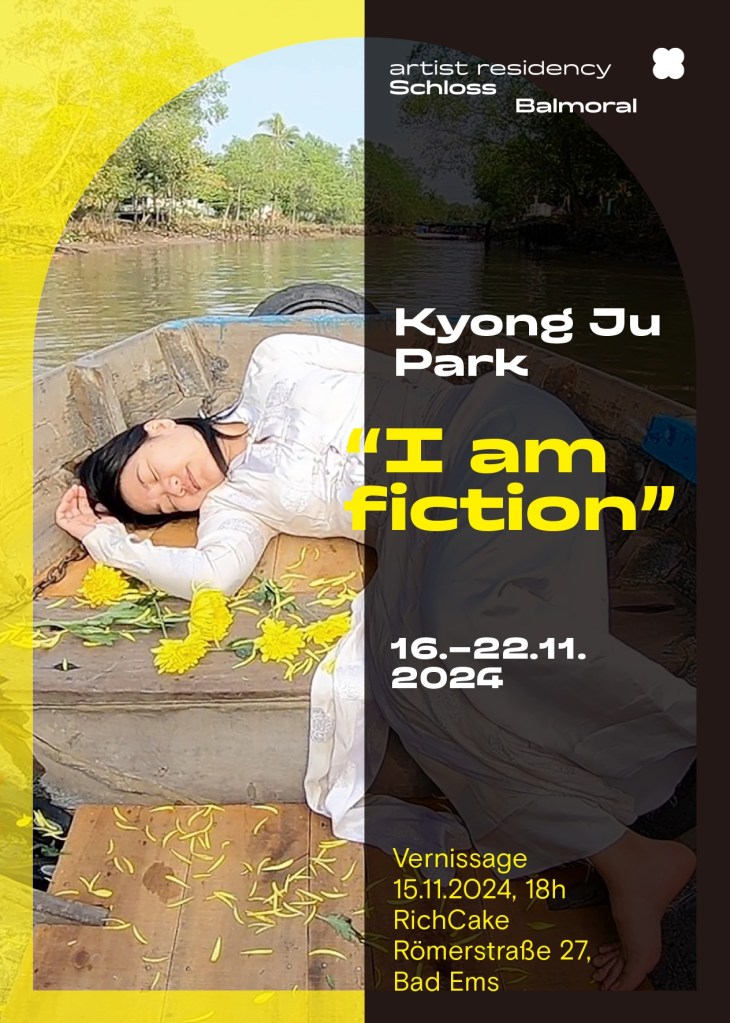
At the artist’s 2024 exhibition held at RichCake as well as the group exhibition at Sayner Hütte, Bendorf, in May 2025, GhostHouse was an es- sential element of a larger installation by the artist. It also included boards leaning against the wall; some were labelled with further quotes from the diary, especially “Fiction” or Korean 허구 und Vietnamese Viễn tưởng or Hư cấu. The artist specifically took the term fiction from her Fiktionsbescheinigung (literally translated as “fiction certificate”), a permit that granted her temporary residence in Germany but did not allow her for example to sell her art. The artist considered this discriminatory compared to her peers from Europe.
The absurd term Fiktionsbescheinigung and the long wait for the paperwork, causing uncertainty and worry, gave Park Kyong Ju the impulse to artistically process her own fictional state and to recognise her connection to Tran Thanh Lan, whose fate she has been dealing with for sixteen years. In her uncertainty about her residency rights, the artist not only felt similar to Tran Thanh Lan – powerless, unwanted – but she also felt as if she did not exist as anything more than a fiction, at least officially.
Park Kyong Ju sees this as an overlap between two fates and as an example for the countless existences of people whose papers – or lack thereof – influence their lives, feelings and deaths. In Tran Thanh Lan’s case, it was not suicide but an unsuccessful attempt at escape that ended her life. At least, this is what Park Kyong Ju firmly believes and what she, as an investigative artist, has tried hard to prove and even bring to the stage. There is plenty of evidence in the police file to support her assumption. A kind of rope was attached to the balcony and was supposed to reach the ground. Examinations of the dead body do not show injuries from a fall from the fourteenth floor but from the seventh to tenth. And finally, the deceased was not found barefoot, which is almost customary in Asia for suicides, and there was no suicide note. Tran Thanh Lan’s husband, on the other hand, strictly rejects the accident theory and arranged for her body to be cremated just two days after her death. The ashes were sent to her mother in Vietnam by post, an illegal act. Above all, this was a humiliation par excellence, as the mother was never able to see her daughter’s body and can never bury it.
The case has caused a stir in Korea and Vietnam, but matchmakers can still make money – albeit under stricter rules – from human trafficking, a situation in which the paying husbands often believe they own their wives. According to Park Kyong Ju, Tran Thanh Lan’s buyer wanted to send his newlywed back to Vietnam after a short time, just like a commodity that is returned or exchanged. Tran Thanh Lan, however, feared the humiliation this would cause in her home country and wanted to stay in Korea, albeit initially as a prisoner
in her husband’s house, guarded by her family by marriage. She confided only in her diary, which served as her witness and refuge.
During Park Kyong Ju’s residency in Bad Ems, she made daily cursive-writings-cum-drawings to free herself from her oppressive feelings. The results can be seen as a way of finding ideas as well as finding herself. One reads, for example, “Park Kyong Ju is fiction.” Others continue: “I am here, but I do not exist,” “Tran Thanh Lan and I are fiction,” “One thousand three hundred and thirty-five thousand five hundred and fifty-eight people, fictional people” and “I write my diary while crying.”
At RichCake, the artist combined both her and Tran Thanh Lan’s fates with artistic means. But that’s not all: Park Kyong Ju also drew connections to Bad Ems in concrete terms and to Europe in general. In Bad Ems, as a non-EU citizen, she experienced an uncertain state of limbo regarding her residency rights. At the same time, she attests to the once-glamorous spa town’s similarly weakened status, as it now searches for stability, orientation and identity. Bad Ems is a city that seems proud only on (historical) paper or because of its history but is currently stum- bling and struggling with a lack of prospects and a fear of recession – much like all of Europe.
- This text was published in the catalogue of the group exhibition INTO. A Festival of Artistic Positions on the Theme of Immersion (Sayner Hütte, Bendorf, Germany, 2025), organized by the Artist Residency Schloss Balmoral. Copyright belongs to Artist Residency Schloss Balmoral.
 PARK KYONG JU